
Postage Stamp Perforations
Postage Stamp Perforations - Why are postage stamps perforated? Web a stamp that is perforated gauge 11 by 10 will have 11 perforation holes per 2 centimeters at the top and bottom of the stamp and 10 perforations per 2 centimeters at the sides of the stamp. If a stamp has 11 perforations in 2 cm, we say it’s “perf 11.”. We use a perforation gauge to measure the number of holes or teeth within two centimeters. To use a stamp perforation gauge: Jun 1, 2016, 5 am.
A helpful article that describes how to correctly measure a stamp's perforations using an instanta type perforation gauge. Web perforations are small rows of holes punched between stamps to make them easier to separate. Web opens in a new window. Issued its first stamps in 1847 and for the first ten years it was necessary to use scissors to separate a stamp from the others printed on the same sheet. It also allows you to measure the distance between any two points on a scanned or photographed image.
Oh, Scrapulous!! Tutorial Faux Perforated Postage Stamp

Web stamp types and perforations. Web perforation involves cutting tiny holes around each stamp, so each stamp can be easily separated. Web apr 29, 2021, 7 pm. Web a stamp that is perforated gauge 11 by 10 will have 11 perforation holes per 2 centimeters at the top and bottom of the stamp and 10 perforations per 2 centimeters at.
What Are Stamp Perforations?

They’re typically measured in points, with 72 points being the standard size, often referred to as “perfs” in collector circles. The article also explains the difference between line and comb perforations, and shows how to identify them. Perforations were introduced to make separating stamps quicker and easier. The inner side frame lines have been recut. This process is essential for.
Pin on Stamps Australia

Jun 1, 2016, 5 am. The gauge works for any stamp, no matter how large or small it is. Here are some tips on how to measure perforations: Web stamp perforation refers to the tiny holes punched through stamps, making them easier to detach from paper sheets. This article will explain perforations to you.
Discworld Stamp Catalogue Perforation Guide
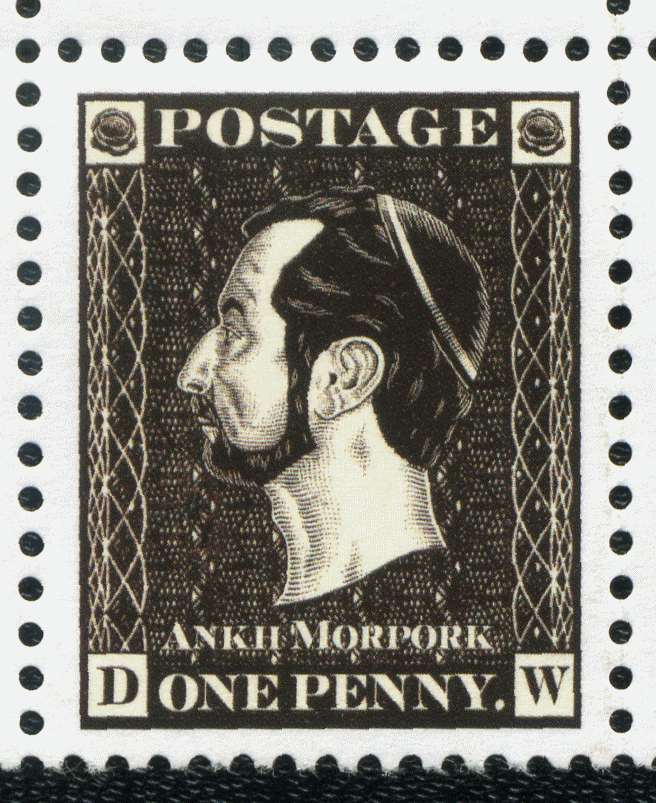
This process is essential for the production and use of stamps, as it allows stamps to. The article also explains the difference between line and comb perforations, and shows how to identify them. Web one of the most important things a collector needs to understand properly is stamp perforations, or “perfs” as they are commonly referred to. Why are postage.
Discworld Stamp Catalogue Perforation Guide

When the world’s first postage stamps were released, no provision was made for separating the. Issued its first stamps in 1847 and for the first ten years it was necessary to use scissors to separate a stamp from the others printed on the same sheet. Comb perfs create uniform corners, while line perfs result in haphazard corners. It also allows.
Postage Stamp Perforations - They come in long rolled strips with straight edges on two opposite sides and perforated edges on the other two sides. Web a stamp that measures perf 11 is one that would have 11 teeth or 11 holes within the confines of two centimeters, if the stamp is that long. The number of holes or teeth within two centimeters is measured using a perforation gauge. We use a perforation gauge to measure the number of holes or teeth within two centimeters. Why are postage stamps perforated? Web perforations are the small holes along the edges of stamps that facilitate separation.
Check the number on the scale; To use a stamp perforation gauge: Web stamp perforation refers to the tiny holes punched through stamps, making them easier to detach from paper sheets. Genuine stamps have a barcode that is printed in relief, which can be felt. Web opens in a new window.
If A Stamp Has 11 Perforations In 2 Cm, We Say It’s “Perf 11.”.
Web perforations are the small holes along the edges of stamps that facilitate separation. This article will explain perforations to you. Perforations have a rich history, revolutionizing stamp production and postal systems. Between 1840 and 1850, people sending a letter had to use knives or scissors to cut their stamps from a booklet or packet of stamps.
Perforations That Do Not Measure The Same On All Four Sides Of A Stamp Are Known As Compound Perforations.
Web the earliest known use of a us perforated postage stamp was on february 28, 1857. Web stamp types and perforations. Why are postage stamps perforated? The stamp analyser digitally measures the stamp perforations, the stamp frame and the balance among the four margins to determine the centering grade of the stamp.
Web Fake Stamps Circulating In The Uk Are Originating From China, A Senior Mp Has Told The Bbc.
Genuine stamps have a barcode that is printed in relief, which can be felt. Web stamp perforation gauges are useful tools for collectors, so it’s worth learning how to use one. The number of holes or teeth within two centimeters is measured using a perforation gauge. Perforations were introduced to make separating stamps quicker and easier.
Most Collectors Are Familiar With Perforation Gauges To Measure The Distance Between Stamp Perforations.
Web the common methods of separation include: There are various types of perforation, including comb perfs and line perfs. Lay your stamp next to your gauge’s scale; They’re typically measured in points, with 72 points being the standard size, often referred to as “perfs” in collector circles.